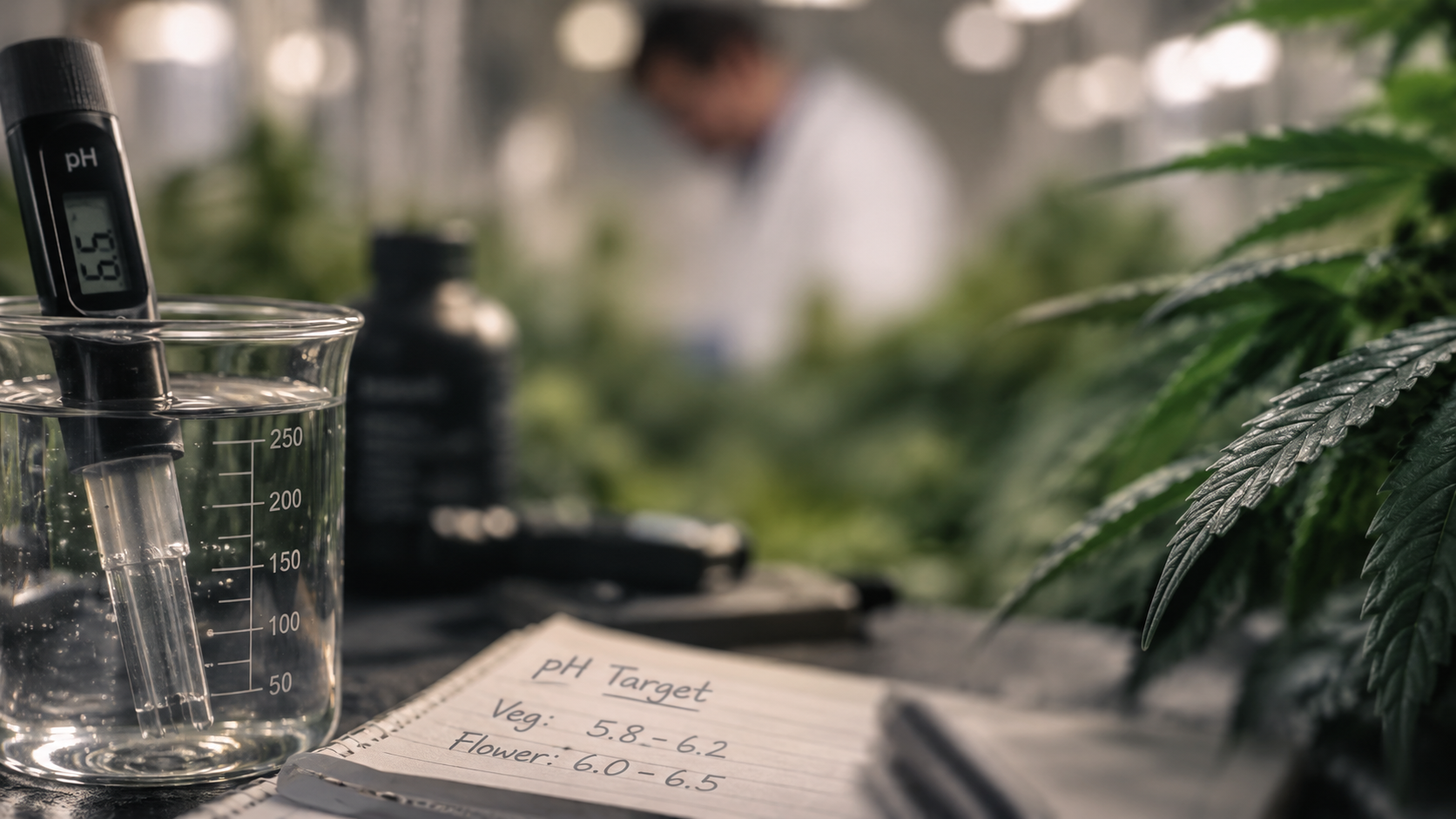
Walk into any grow room that's struggling and you'll hear the same theories. Bad genetics. Spider mites. Lockout from the last feed. Growers will spend hundreds of dollars on IPM sprays, replacement clones, and new nutrient lines before they ever pick up a pH pen and actually check their water.
Here's the uncomfortable truth: pH is the single most important variable in your entire grow, and most people treat it like an afterthought.
What pH Actually Controls
Every nutrient your plant needs - nitrogen, phosphorus, potassium, calcium, magnesium, iron, zinc - has a specific pH window where it becomes available at the root zone. Outside that window, the nutrient is physically present in your solution but chemically locked. The plant can't absorb it. You're feeding your plants and starving them at the same time.
In soil, the sweet spot is roughly 6.0–7.0. In coco or hydro, you're targeting a tighter 5.5–6.5. Even a half-point drift outside those ranges starts creating deficiencies that look exactly like nutrient problems - because they are nutrient problems, just not the kind you can fix by adding more nutrients.
The Swing Problem
A single bad reading isn't the real danger. The real danger is swing - when your pH bounces between 5.2 and 7.1 over the course of a week. Different nutrients lock out at different pH levels, so a swinging pH creates a rotating deficiency cycle. You correct what looks like a calcium deficiency, then iron shows up, then you're chasing magnesium. The plant never stabilizes. Yield suffers. You blame everything except the actual problem.
This is especially common in recirculating systems where plant uptake, evaporation, and microbial activity all affect pH simultaneously. If you're not checking pH at least once daily in a recirculating setup, you're flying blind.
How to Actually Stabilize pH
First, calibrate your meter. A pH pen that hasn't been calibrated in two weeks is giving you fiction. Use fresh 4.0 and 7.0 calibration solution, calibrate before every major feed, and replace your probe every 12–18 months. A $15 probe giving you bad data is more expensive than a $120 probe giving you accurate data.
Second, pH your water after you've added all nutrients - not before. Nutrients change the pH of your solution. If you pH first and then add nutes, you're starting over. Build your feed, then adjust to target.
Third, use a quality pH up and pH down. Cheap pH adjusters are inconsistent and can introduce contaminants. We use and recommend pharmaceutical-grade phosphoric acid for down and potassium hydroxide for up. They're stable, clean, and predictable.
The Bluelab Standard
At VIP Growers, we run Bluelab meters on every build. The Bluelab Combo Meter gives you pH, EC, and temperature in one unit. The pH Pen is our go-to for quick spot checks. These aren't the cheapest options on the market - but when your crop is worth thousands of dollars per light, the meter is not where you cut corners.
Get your pH dialed. Check it every day. Calibrate your meter. Do that consistently for 30 days and watch how many of your 'deficiency problems' disappear on their own.
Most growers think of enzymes as a cleanup crew. You add them to your reservoir, they break down dead root matter, and your root zone stays cleaner. That's true - but it's about 5% of what enzymes are actually doing in your grow.
The real story is about speed. Biological reactions happen in your root zone constantly - nutrient conversion, organic matter decomposition, microbial metabolism. Without enzymes, these reactions happen at their natural rate. With the right enzymes at the right temperature, those same reactions happen up to 1,000,000 times faster.
What Enzymes Actually Are
Enzymes are biological catalysts - proteins that accelerate chemical reactions without being consumed in the process. They work by lowering the activation energy required for a reaction to occur. Think of them as a key that unlocks a door. The door was always there. The key just makes it open instantly instead of waiting for someone to break it down.
In your root zone, the most important enzymes are cellulases (break down plant cell walls), proteases (break down proteins into amino acids), and phosphatases (convert organic phosphorus into plant-available forms). Each one is doing something specific, and each one is doing it at a rate that would take weeks or months without enzymatic activity.
The Temperature Factor - Why Hot Enzymes Matter
Enzyme activity is highly temperature-dependent. Most plant-derived enzyme products are optimized for temperatures between 60–75°F. But many commercial grow rooms run warmer - especially in summer or in rooms with high light intensity. At elevated temperatures, standard enzyme products denature (break down) and stop working.
Thermostable or hot enzymes are engineered to remain active at higher temperatures - some up to 95°F or beyond. This matters enormously in a commercial setting where reservoir temps can climb and you can't always afford to chill your water to optimal levels. A hot enzyme product keeps working when a standard product has already failed.
What This Means for Your Root Zone
When enzymes are working at full capacity, dead root matter gets broken down before it can become a breeding ground for pathogens. Organic compounds that would otherwise sit in your medium for weeks get converted into plant-available nutrients within hours. Your roots stay white and healthy because the environment they're living in is clean and biologically active.
The downstream effect is significant. Cleaner root zones mean better oxygen uptake. Better oxygen uptake means faster metabolism. Faster metabolism means faster growth, better nutrient uptake efficiency, and ultimately - more yield per watt.
Enzymes and Your Microbial Program
Enzymes and beneficial microbes work together, not in competition. Enzymes break complex organic molecules into simpler compounds that microbes can then consume and process further. If you're running a microbial program - mycorrhizae, trichoderma, beneficial bacteria - adding a quality enzyme product amplifies what those microbes can do. You're essentially pre-digesting the food supply for your biology.
Plagron's Pure Zym is one of the products we run regularly on builds. It's a concentrated enzyme formula that covers the major enzyme classes and remains stable across a wide temperature range. Pair it with a solid microbial inoculant and you've built a root zone that's genuinely alive and working for you.
The Takeaway
Enzymes aren't a luxury add-on. They're a fundamental part of how biology works. If you're growing in any organic or semi-organic medium, or running any kind of recirculating system, enzymes should be a non-negotiable part of your program. The 1,000,000x acceleration isn't marketing language - it's biochemistry. Use it.
There's a version of this conversation that happens on almost every commercial consultation we do. The grower has dialed-in genetics, a solid nutrient program, good lights. The canopy looks okay. But the numbers aren't there. Yield per light is mediocre. Terpene expression is flat. The crop is surviving, not thriving.
Nine times out of ten, the answer is VPD.
What VPD Is and Why It Matters
VPD stands for Vapor Pressure Deficit. It's a measurement of the difference between the amount of moisture currently in the air and the maximum amount of moisture the air could hold at that temperature. In practical terms, it tells you how hard your plant is working to transpire.
When VPD is too low (high humidity, low temperature), transpiration slows down. The plant isn't pulling water and nutrients through its system efficiently. Growth stalls. Pathogen pressure - especially powdery mildew and botrytis - increases dramatically because the leaf surface stays wet.
When VPD is too high (low humidity, high temperature), the plant closes its stomata to prevent water loss. Photosynthesis slows. CO2 uptake drops. The plant is stressed and spending energy on survival instead of growth.
The Target Numbers
For cannabis specifically, the general targets are: Seedling/Clone - 0.4–0.8 kPa. Vegetative - 0.8–1.2 kPa. Early Flower - 1.0–1.5 kPa. Late Flower - 1.2–1.6 kPa. These aren't arbitrary numbers - they reflect the plant's changing water demand and pathogen risk profile across its life cycle.
The key insight is that VPD is a function of both temperature AND humidity together. You can't manage VPD by controlling only one variable. A room at 75°F and 60% RH has a very different VPD than a room at 80°F and 60% RH. This is why growers who only track temperature or only track humidity are missing half the picture.
Where HVAC Comes In
Your HVAC system is your primary VPD management tool. A properly sized and configured HVAC system gives you independent control over temperature and humidity - which means you can actually hit your VPD targets instead of just hoping the conditions happen to be right.
The most common mistake we see on commercial builds is undersized dehumidification. Growers spec their cooling correctly but underestimate how much moisture a canopy of transpiring plants puts into the air. A 10-light room in peak flower can put hundreds of gallons of water vapor into the air per day. If your dehumidifier can't keep up, your RH climbs, your VPD drops, and you're in the pathogen danger zone.
Practical Steps to Dial In Your VPD
Start by getting accurate data. A single temperature/humidity sensor in the corner of your room is not enough. You need sensors at canopy level - that's where the plant is actually experiencing the environment. Ideally, you have multiple sensors distributed across the canopy and you're logging data continuously.
Use a VPD chart or calculator to find your target temperature/humidity combination for your current growth stage. Then work backward to figure out what your HVAC system needs to do to hit those numbers. If your system can't get there, that's a capacity problem - not a settings problem.
Finally, don't neglect airflow. Stagnant air creates microclimates - pockets of high humidity around dense canopy areas that your sensors never see. Oscillating fans, horizontal airflow fans, and proper circulation keep the environment uniform and prevent the hot spots and wet spots that invite disease.
The Bottom Line
Environment is not a secondary concern. It's not something you figure out after you've dialed in your nutrients and your lights. It's the foundation everything else sits on. Get your VPD right, get your HVAC sized correctly, and watch what happens to your numbers. The genetics and the nutrients were always there. You just gave them the conditions to actually perform.